千王之王
A star in BRI cooperation_我的网站

A |
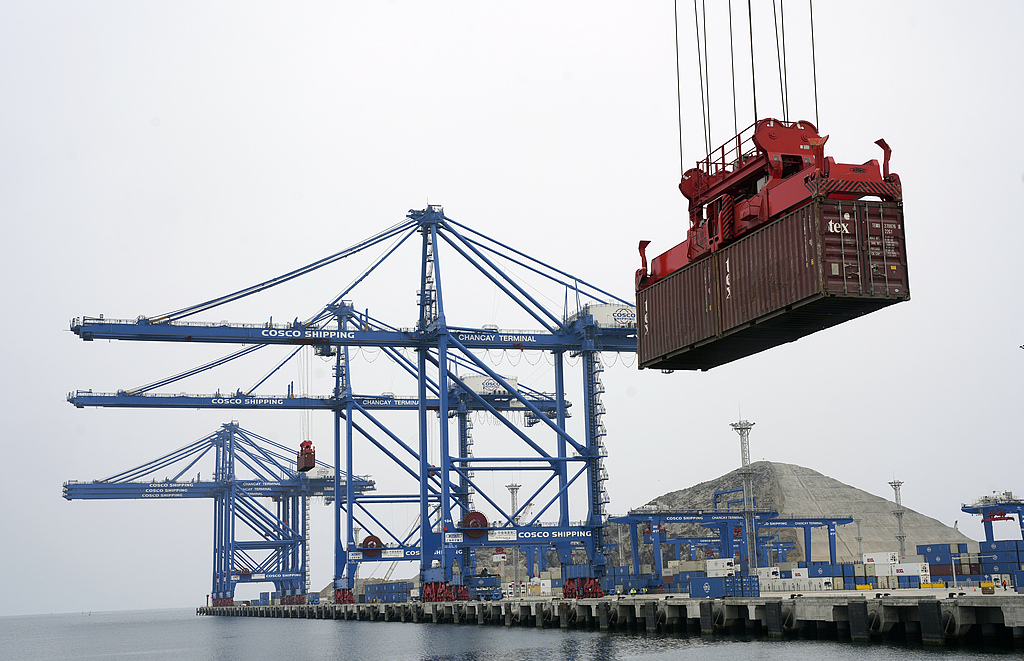
A crane lifts a container at a terminal of the Chancay Port, Peru. File photo: VCG
Nearly two years after its launch, Chancay Port has entered a phase of rapid growth. As an important logistics hub in Peru, the port is accelerating the development of a new Latin America-Asia ocean shipping lane, while intensifying connection and cooperation between many Latin American countries and China.
Recently, China's COSCO Shipping Lines launched the CHX3 (Chancay Express Service 3) feeder service, marking the first regular weekly operation linking Peru's Paita Port, Chancay Port and Costa Rica's Caldera Port.
The new service represents COSCO Shipping's latest effort to expand its presence along South America's west coast, using Chancay Port as a key transshipment hub to support foreign trade channels there. It is one of the latest expansions of COSCO Shipping's regional shipping network.
The launch of CHX3 will further expand Chancay Port's regional reach, providing foreign trade companies in Peru and other Latin American countries with a more stable and efficient logistics route to Asia, Chinese experts said.
As a deep-water port and South America's first smart green port, Chancay Port is a flagship Belt and Road Initiative (BRI) cooperation project between China and Peru. Amid rising unilateralism and geopolitical tensions in the world, the port is playing an increasingly important role in supporting the stability of global supply chains, the experts said.
New shipping routesLocated in northern Peru, Paita Port is a key container and cold-chain hub serving major industrial areas such as Piura and Lambayeque, home to numerous foreign trade companies in agriculture, seafood processing, mining and textiles. The new CHX3 service has improved logistics efficiency, providing exporters with a more efficient logistics channel to China and Asia at large.
The new service, which provides a direct link to Chancay Port and connects with many trans-Pacific ocean routes, will help shorten overall transport time for fresh fruits, reduce cargo loss risks and reduce transportation costs, Peruvian fruit exporter Ecosac said, noting that it will also further expand access for Peruvian fresh fruits to China and other Asian markets.
The role of Chancay Port in expanding China-Latin America shipping network is undergoing significant changes as envisioned, Tang Jie, an expert at the Institute of American and Oceanian Studies at the Chinese Academy of International Trade and Economic Cooperation, told the Global Times on Thursday.
Tang said that the launch of the CHX3 service has connected ports along the west coast of South America and in Central America, significantly reducing transshipment costs and transit time. With its efficient operations, Chancay Port is reshaping the logistics landscape on South America's west coast, boosting trade among regional countries and becoming a "catalyst" for greater economic integration in South America, said Tang.
The impact of Chancay Port on regional connectivity is evident. Since its opening in November 2024, the sea transport time between Peru and China has been shortened to 23 days, cutting logistics costs by 20 percent.
Nearly two years after its inauguration, Chancay Port has generated $3.65 billion in import and export trade, handled 500,000 TEUs of containers, and contributed more than 1.64 billion Peruvian soles in tax revenue to Peru. The port now operates three trans-Pacific trunk routes linking Asia with South America, along with five regional feeder services connecting countries along the continent's western coast.
And, new shipping routes have been launched since earlier this year. On March 31, a direct route linking Taicang Port in East China's Jiangsu Province and Chancay Port opened, cutting transit time to just 26 days. The 7,500-vehicle-capacity LNG dual-fuel vessel Kaiyuan Kou departed Taicang Port carrying Chinese-made EVs and other equipment directly to Chancay Port.
On May 4, a new shipping route between Nanjing Port in Jiangsu and Chancay Port was launched, creating a convenient logistics link between the Yangtze River Economic Belt and the South American market.
In the same month, South China's Guangzhou launched its first direct shipping route to Chancay Port, expanding trade links between Guangdong-Hong Kong-Macao Greater Bay Area and South America.
Zhang Jieyu, assistant research fellow at the Department for Latin American and Caribbean Studies, China Institute of International Studies, told the Global Times on Thursday that the launch of COSCO Shipping's new feeder service and the continued expansion of shipping routes show that the port's role in China-Latin America shipping and trade is undergoing a major shift.
Also, the new shipping routes help improve operational efficiency and ensure stable supplies of key resources such as copper and lithium to China, Zhang said, noting that lower logistics costs support local manufacturing too, assisting Latin American companies to integrate deeply with the global supply chains, in addition to creating many local jobs.
Greater prospectsIn 2025, Chancay handled a total container throughput of 336,200 TEUs, while its bulk cargo and roll-on/roll-off operations reached 1.595 million tons. Currently, the port has launched three trans-Pacific trunk routes, as well as regional feeder services covering multiple countries along South America's western coast.
The port is expected to generate $4.5 billion in annual economic benefits for Peru, contributing 1.8 percent to the country's GDP. The port is also projected to create more than 8,000 jobs, many in logistics and transportation. By boosting local employment and regional economy, Chancay Port becomes a major pillar of Peru's development strategy, the People's Daily reported.
In a previous interview with the Global Times, Ambassador of Peru to China Carlos Vasquez said that "China's efforts to stimulate domestic consumption could create new opportunities for Peruvian exports of healthy and high-quality products."
Under the framework of high-quality BRI cooperation, Chancay Port's expanding shipping network will bring greater certainty to China-Latin America trade. By shortening transit time and improving cargo efficiency, the port will create a more reliable maritime link, providing important trans-Pacific shipping options to strengthen global supply chain resilience, said Zhang.
Chancay Port has significant growth potential. Zhang said that the port can further expand feeder networks along the western coast of South America and Central America, extending connectivity to landlocked Andean countries. Meanwhile, deeper digitalization and AI integration will help turn the port into a model for China-Latin America supply chain cooperation, promoting broader industrial collaboration and supporting regional development.
And, as a green and smart port, Chancay Port's experiences in energy conservation, emissions reduction, automated operations and digital customs are expected to set a benchmark for Latin American ports, said Tang, adding that the port is expected to play an important role in advancing the Green Silk Road and Digital Silk Road initiatives.
。 武汉8月21日电(记者王承昊、余熙)2026年两岸关系研讨会20日至21日在武汉举行,160余位两岸有关人士和专家学者围绕“坚守民族大义 共谋复兴伟业”这一主题集思广益、畅所欲言。

B | 与会人士认为,两岸同胞同根同源,是休戚与共的命运共同体,要站在历史正确的一边、民族正义的一边。广大台湾同胞要顺应历史大势、秉持民族大义,和大陆同胞一道守护中华民族共同家园,为推进国家统一、谋求民族复兴共同奋斗。

C | “统一势在必行,台湾民众不要误以为可以永远‘维持现状’。”台湾《观察》杂志发行人纪欣说,部分台湾民众对统一的最大担忧是怕不能保有现行的社会制度和生活方式,但制度不同不是分裂的借口,只要承认两岸同属一中,两岸随时可以通过平等协商谈判,实现和平统一。希望更多台湾同胞能树立正确的国家和民族认同,发挥爱国主义传统,把推进国家完全统一当作自己的一项光荣事业。 全国台湾研究会副会长王卫星认为,台湾社会很有必要理性看待大陆发展与两岸统一前景。大陆提出的“一国两制”是立足两岸同胞福祉的安民良策,充分尊重台湾现有社会制度、生活方式与风俗习惯,全面保障台湾同胞财产、医疗、就业等合法权益,最大限度规避战争风险,让台湾同胞深度共享中华民族伟大复兴的时代红利。 研讨会上,与会人士分析当前台海形势和台湾前途所在,表达了对实现祖国完全统一的强烈愿望,并积极建言献策。台湾铭传大学两岸研究中心主任杨开煌提出,可以善用先进技术赋能两岸交流。他认为,大陆的进步是实打实的,应通过AI智能生活、人机协作等新鲜体验,让台湾同胞尤其是青年到大陆体验一种“未来感的生活”,看到大陆未来发展的无限可能,促进两岸和平发展与深度融合。 台湾亚太综合研究院高级研究员钟琴表示,两岸关系一大症结是台湾民众的错误认知惯性。岛内民众获取大陆客观资讯渠道受限,叠加民进党当局制造的“寒蝉效应”,部分人由此产生对大陆的排斥心理。当前大陆发展成就举世瞩目,国际社会深度关注大陆治理实践,这一聚光灯效应有助于台湾青年看见大陆发展机遇,逐步消解偏见。 全国台联副会长杨毅周表示,长期以来,“台独”分裂势力大肆推动“去中国化”,试图将台湾同胞的认同引向错误方向。

D | 但当前台湾社会认同尚未固化,仍可建构和转化。随着两岸关系不断发展、中国式现代化不断推进,台湾同胞建构正确国家认同的趋势越来越明显。我们要继续深化两岸各领域融合发展,促进两岸同胞不断相互了解、理解、尊重和认同。 “两岸同胞携手守护中华民族共同家园天经地义,是不容置疑的历史使命,每个人都可从自身角度和条件出发参与其中。”上海东亚研究所所长王海良呼吁,台湾同胞要增进对祖国大陆大好河山和社会巨大进步的了解,增进对和平统一利于两岸、区域和全球的认识,与“台独”分裂势力和外来干涉势力进行坚决斗争,与大陆同胞一同克难奋进,坚守民族大义,携手开创美好前景。
Current article:http://kekwmp.dingruorenhongqiaminmeipeiliu.cyou/svian/20260826/4493.html
Published on:04:05:49